introducing the Cold gas subgrid model (CGSM)
Check out the full text on the arXiv, or see the code for yourself on github!
Cold gas accounts for a significant fraction of all galactic baryons, yet current galaxy-scale simulations cannot reliably model it. The fundamental problem is one of dynamic range: cold CGM clouds are theoretically expected to be as small as 0.1–10 pc, while the CGM in cosmological simulations is typically resolved at ~1 kpc or coarser. In this regime, traditional hydrodynamics produces unphysical results — cold gas clumps into artificially inflated clouds, and formation, destruction, and growth all occur on the wrong timescales.
In this work, we introduce the Cold Gas Subgrid Model (CGSM): a two-fluid framework that treats unresolved cold gas as a separate fluid evolving alongside the standard hot gas (Figure 1). Rather than requiring simulations to directly resolve cold cloudlets, the CGSM tracks their total mass density and bulk momentum, inferring their physical properties from the surrounding hot gas. The interactions between the two fluids — mass, momentum, and energy exchange — are governed by prescriptions drawn from high-resolution cloud-crushing and thermal instability simulations.
The payoff of this approach becomes clear when comparing cold gas distributions across resolution levels (Figure 3). A high-resolution traditional simulation produces a realistic, nearly uniform mist of ~10 pc cloudlets throughout the CGM. A low-resolution traditional simulation at the same conditions instead concentrates cold gas into a handful of large, kpc-scale blobs — an artifact of the resolution, not physics. The CGSM, running at that same low resolution, successfully recovers the correct smooth spatial distribution of cold gas mass, without ever directly resolving the cloudlets themselves.
The CGSM represents a path toward enabling cosmological simulations to faithfully model the role of cold gas in the galactic baryon cycle — without waiting decades for the computational resources needed to resolve it directly.
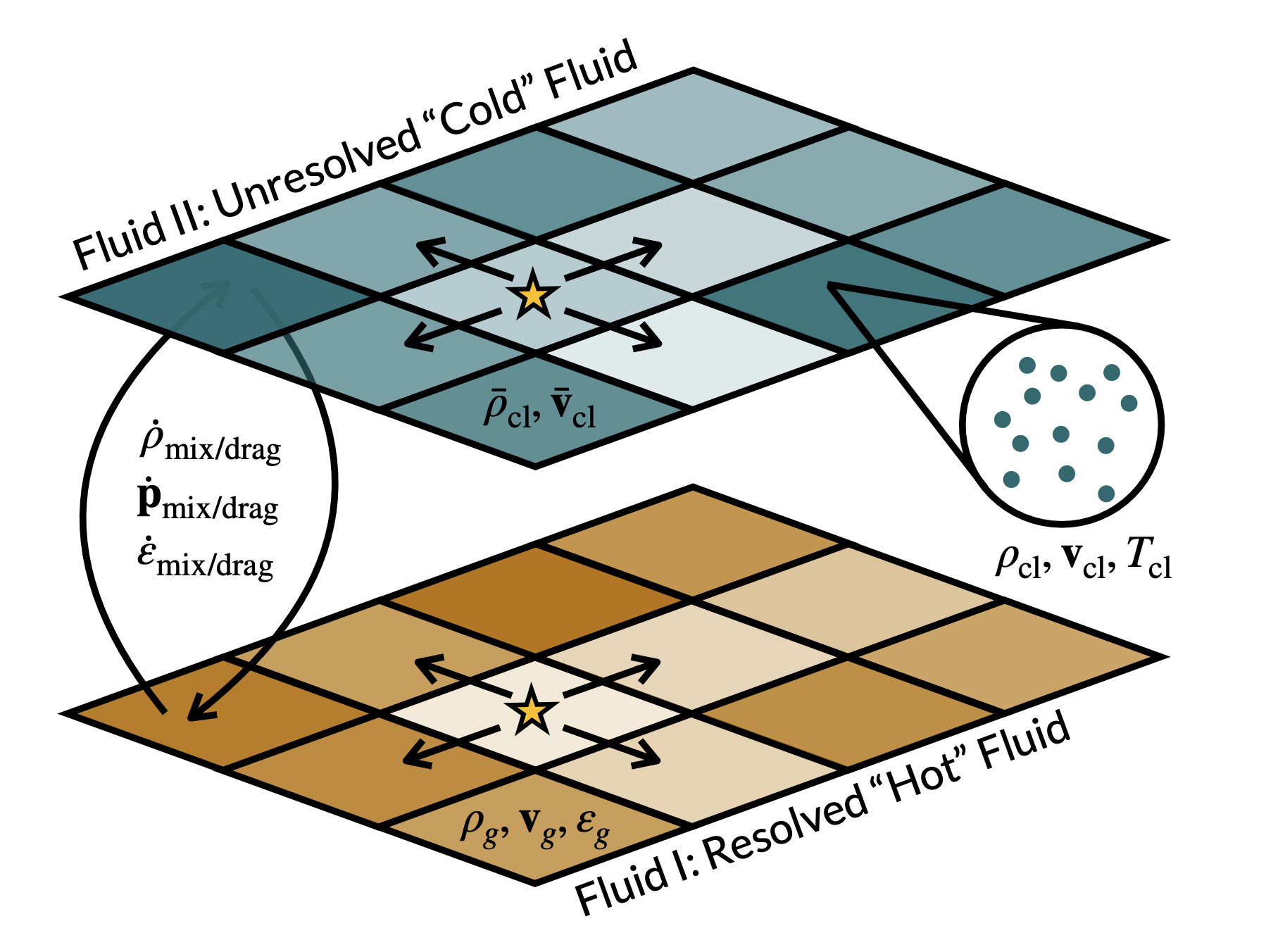
Figure 1: A schematic of the CGSM two-fluid framework. Each simulation cell simultaneously evolves a standard "hot" fluid and a second, unresolved "cold" fluid representing an ensemble of tiny cold cloudlets. The two fluids interact by exchanging mass, momentum, and energy according to prescriptions informed by high-resolution simulations of thermal instability and cloud crushing.
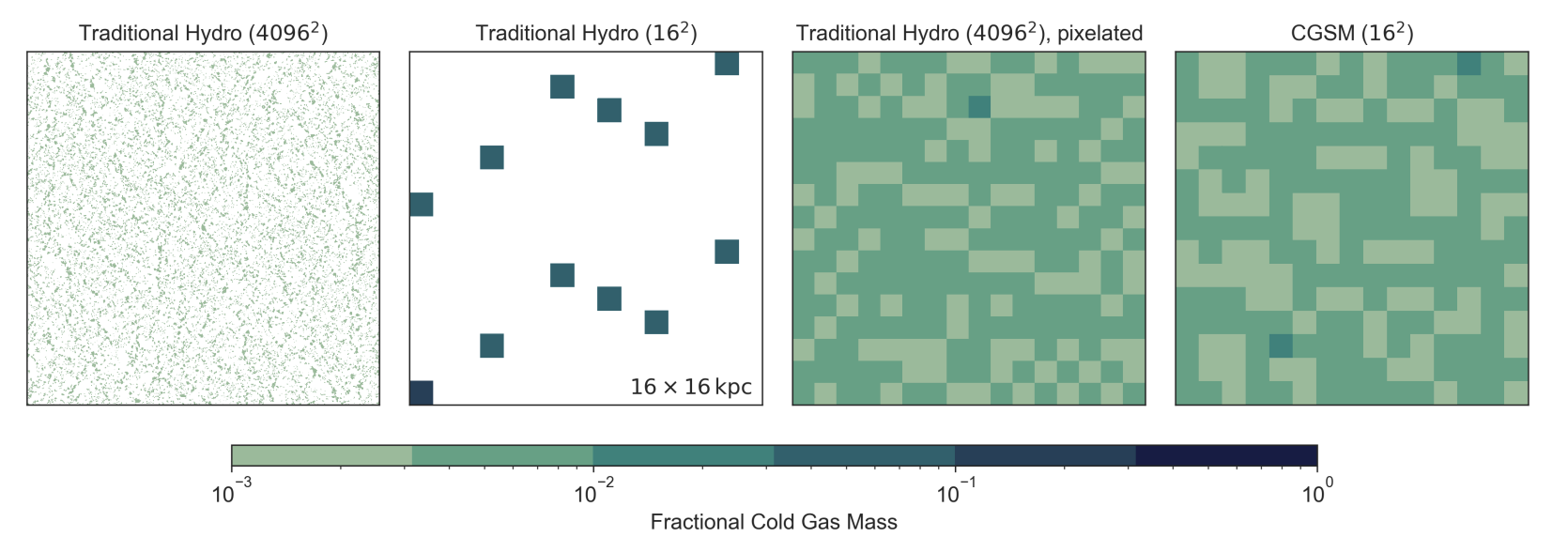
Figure 2: A comparison of cold gas distributions in a 16×16 kpc patch of CGM gas across four simulations. From left to right: a high-resolution traditional simulation (correctly producing a uniform mist of ~10 pc cloudlets), a low-resolution traditional simulation (artificially concentrating cold gas into a few kpc-scale blobs), the high-resolution result binned down to low resolution (showing what the correct answer looks like at that scale), and a low-resolution CGSM simulation (successfully recovering the smooth, realistic cold gas distribution without directly resolving the cloudlets).